
Annual Planning for a Small Business: A Five-Step Process Your Team Can Own
Annual planning for a small business comes down to five steps your whole team works through together: look back at last year, pick three priorities, give each one a point person and a measure, break the year into quarters, and set up a regular rhythm of check-ins. What comes out the other end isn’t a promise. It’s a forecast – one that points everyone in the same direction and gets adjusted as the year teaches you things.
There’s a principle buried inside that last sentence that deserves a closer look. Most of us were taught that a good plan is a detailed one, and that sticking to it is a sign of discipline. It isn’t. A plan defined too tightly starts to replace the goal it was written to serve. The team gets very good at executing the plan and quietly loses sight of what the plan was for.
We watched this happen with a technical services team we worked with. Their annual plan was built around customer satisfaction, and they measured it by whether they delivered the exact list of updates each customer asked for at the start. It was a reasonable measure. It was easy to count.
A few months in, they noticed something. Customers weren’t happiest when they got what they’d asked for. They were happiest when they got the features they turned out to need – and those often looked different from the original request.
So, the team changed the plan. Had they held on to that first measure all year, they would have kept checking boxes for customers who got exactly what they asked for and still walked away unhappy, and some of that future business would have gone somewhere else. Because they kept learning as they went, the plan served the goal instead of fighting it.
What is annual planning for a small business?
Annual planning is the yearly session where the team agrees on the few things that matter most next year, who will keep each one in focus, and how progress will be checked. In a small business, it’s less about producing a long document and more about getting the plan out of the owner’s head and into the hands of the people who’ll carry it.
It helps to think of it not as a commitment, but as a forecast. You take what last year taught you, add the opportunities you can see coming, and decide where the team should put its attention. Like a weather forecast, it’s fairly reliable for next week and a good deal fuzzier for next fall — and that isn’t a flaw in the forecast. It’s simply how the future works.
Why most small business plans are dead by March?
When a plan falls apart by March, most owners take it personally. They decide they weren’t disciplined enough, didn’t follow up enough, didn’t push hard enough. That’s almost never the problem. The problem is usually how the plan was built — and in our experience, it tends to come down to three things.
The plan lives with the owner. The owner knows why each goal matters and what got traded away to make room for it. The team only sees the list. So when a big customer leaves or a supplier raises prices, nobody else can tell which parts of the plan still hold, and every question finds its way back to the owner’s desk. That isn’t a team that doesn’t care. It’s a team that was never handed the reasoning.
There are ten priorities instead of three. With ten priorities, each one gets a sliver of attention. By March the day-to-day work has crowded most of them out, and people have quietly started working on whichever ones they like best. That isn’t a focus problem in the people. It’s a focus problem in the plan.
Nobody owns anything except the owner. A priority assigned to “sales” or “operations” has no one keeping it in view, so it quietly drifts until the owner notices and starts chasing it – which is the very habit the plan was supposed to break. The answer isn’t to find someone to hold responsible. It’s to make the goal everyone’s, and give one person the job of keeping it in focus.
Underneath all three sits a quieter problem, one we’ve come to think of as the over-written plan. Most plans spell out far too much of the how. Write October’s tasks in December and you’ve committed to a path before you know what the year will bring. The more of the how you lock in early, the less room the plan has to learn. Leave it that room.
Step 1: Look back before you look ahead
Before anyone suggests a new goal, spend real time with the year you just had: what got done, what you learned, and what slipped through the cracks. Work through these questions as a team, and push gently for real examples rather than general impressions.
- What worked, and why?
- What broke, and what about the way we work let it break?
- Where did decisions sit waiting on the owner?
- Which incentives helped people hit our goals, and which worked against them?
- What should we stop doing?
That last question usually gets the least airtime, and it tends to deserve the most.
When something went wrong, look at the system before the person. It’s tempting to ask who dropped this? The more useful question is what about our structure, handoffs or incentives made this miss likely? The first question finds someone to blame. The second tells you what has to change next year.
Step 2: Pick three priorities, not ten
Start at the end of next year and work backward. An exercise called Remember the Future works well here. Ask everyone to imagine it’s next December and the year went well, then write down what happened – for customers, for the team, and in the numbers. Then compare notes and ask: what had to be in place to get there, and what did we need that we don’t have today?
You’ll end up with a long list. That’s expected. Here’s how we narrow it down:
- Group the ideas that are really the same outcome said in different ways.
- For each one, sort what it needs into what you already have, what you’d need to add, and what you’d need to stop doing.
- Pick the three that would make the most other things easier – or no longer necessary at all.
Narrowing to three can feel like giving up on the other seven. It isn’t. It’s deciding, on purpose, what the team won’t spend itself on this year.
Watch out for vague priorities, too. “Improve customer service” sounds good, but nobody can tell when it’s done. Compare it with “Get quotes back to customers in two days instead of five, so we hear from them while they’re still deciding.” The second one has a result, a number, and a reason people can get behind.
Step 3: Give every priority one point person and one measure
Every priority belongs to the whole team. What each one also needs is a point person – one person, not a department, whose job is to keep it in focus. They don’t do all the work, and they aren’t the one who takes the fall if it slips. Their role is to keep the priority visible, pull in help, and raise a flag early when it starts to drift, so the team can respond together.
That distinction matters more than it looks. When the name next to a goal becomes the name to blame, people start protecting themselves: they promise less, report later, and stop asking for help when they need it most. This isn’t accountability as blame. It’s accountability as focus – one person making sure the whole team never loses sight of what it committed to.
The measure should be a number or a clear yes or no, so anyone in the business can see whether it’s on track.
Make sure the measure tracks the goal and not just the activity. For the technical services team, “delivered the original request” was easy to count, but it wasn’t what made customers happy. A measure is only useful for as long as it points at the thing you care about. When it starts pointing the team somewhere else, change the measure, not the goal.
Then look at your incentives. If sales is paid on volume and operations is judged on margin, those two teams will pull against each other no matter how good the people are. That isn’t a people problem. It’s a system problem. One set of company goals that every team shares will do more than a bonus tied to one department’s number.
It’s also worth thinking past rewards and penalties. Carrots and sticks work well enough for simple, repetitive tasks. For work that takes judgment, Daniel Pink’s book Drive points to three things that motivate people from the inside: autonomy, mastery and purpose. Here’s how each one can show up in your plan:
- Autonomy. The plan says what you’re after and why. The point person and the team decide how.
- Mastery. Name the skill each priority will help people build, and give them room to practice it.
- Purpose. Connect every priority to something a customer or the company will actually notice.
Step 4: Turn the year into four quarters
For each priority, write down what needs to be true by the end of each quarter. How much detail you add should depend on how far out you’re looking. This is what’s known as the cone of uncertainty: you can see the next few months reasonably well, but the further out you go, the more can change.
So plan the first quarter in detail, including milestones and who’s doing what. For the second quarter, set clear outcomes. For the third and fourth, a target and a general direction are enough. You’ll fill in the how once you’re closer and know more.
This can sound like planning less. It’s closer to planning honestly — putting detail where you can actually see, and leaving the rest open until you can.
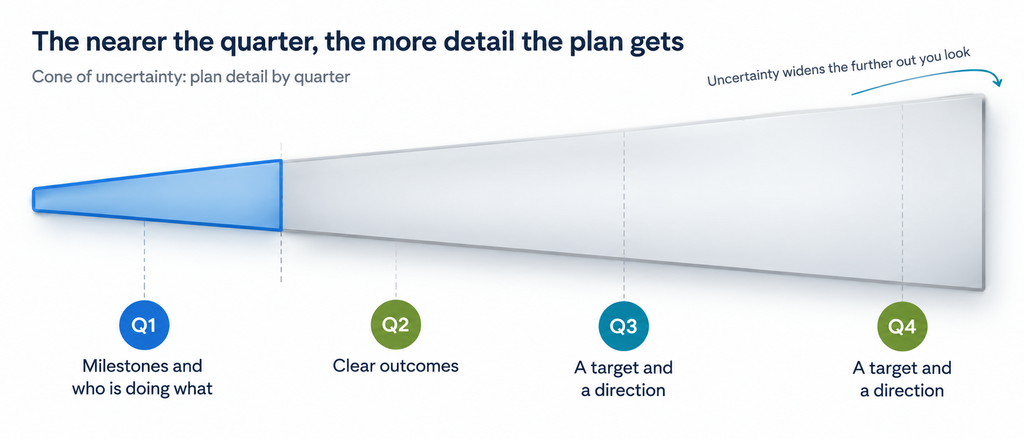
Cone of uncertainty · plan detail by quarter
The nearer the quarter, the more detail it gets. At each quarterly reset, you fill in the next quarter based on what you’ve learned.
Here’s how that might look for the quote turnaround example:
- Q1: Map how a quote moves through the business today, measure how long it really takes, and fix the two biggest delays.
- Q2: Standard quotes go out within two days.
- Q3: Custom quotes follow the same process, aiming for three days.
- Q4: The two-day turnaround holds without the owner checking every quote.
In our experience, a quarter is about long enough for most teams to see real, measurable movement, which makes it a natural stretch for checking in and adjusting.
Step 5: Set the rhythm that keeps the plan alive
The annual plan gives you direction. The shorter cycles inside it are what move it forward – and what give you regular, built-in chances to change course. Three check-ins carry most of the load.
- Weekly check-in (~30 minutes). Each point person covers what moved, what’s stuck and what they need. The team plans the week and clears whatever’s in the way. If your team finds it useful, a quick daily touchpoint keeps things moving in between.
- Monthly review (~60 to 90 minutes). Look at whether each measure is moving, and have people show what they finished rather than just describe it. Close with a few minutes looking back: what helped, what got in the way, and what you’ll try next.
- Quarterly reset (~half a day). Plan the next quarter in detail, then step back and ask the bigger questions. Does the strategy still make sense? Has anything you’ve learned changed a priority, a measure or the plan as a whole? Are your incentives helping or getting in the way?
If something big happens – a major customer leaves, a key person moves on – don’t wait for the quarter to end. Have that conversation now. A plan that never changes all year is rarely a sign of a good plan. It’s usually a sign that nobody’s looking at it.
Who should be in the room
Bring in the whole team – not just the leadership team, and certainly not just the owner. It can feel more efficient to plan with a small group and roll the plan out afterward. It isn’t. A plan people receive is a plan they comply with. A plan people help build is a plan they commit to.
That difference shows up all year. When people comply, they wait to be told and react to the goals as they arrive. When they commit, every person is leaning into the goals instead of reacting to them – noticing what’s drifting, offering ideas, adjusting without being asked.
The people closest to customers and the day-to-day work also tend to see what broke more clearly than anyone in leadership does. Their answers to the look-back questions are often where the most useful part of the session begins.
Frequently asked questions
When should a small business do annual planning?
Between November and mid-December, wrapped up before January 15. By then most of the year is behind you and still fresh in everyone’s mind, and your team starts January knowing its priorities instead of working them out in February.
How long should annual planning take?
Plan on one full day, or two half days, with your whole team. A rough split is a third of the time looking back, a third picking priorities and point people, and a third mapping out the quarters and setting up check-ins.
What is the difference between annual planning and strategic planning?
Strategic planning sets your direction for the next three to five years: where the business is headed and why. Annual planning takes that direction and turns it into this year’s focus — three priorities, a point person and a measure for each, and a plan for each quarter.
Is your business ready to plan this way?
A plan your team owns only works if the business can run without every decision going through you. That isn’t a question of how capable you are. It’s a question of how the business was built — and most owners built theirs, quite sensibly, around themselves.
If you’re not sure how close you are, take the Are You Ready? Business-as-a-System check. It’s quick, and it’ll show you where decisions, ownership and your meeting rhythm are getting in the way, so you walk into your planning session knowing where to start.
And before that session, sit with the harder question for a minute: which parts of next year are you still planning to carry alone?
Notice them. Name them. Then hand one over.
-M
Leave a Reply