
Why is My Business Profitable but I Never Have Any Cash?
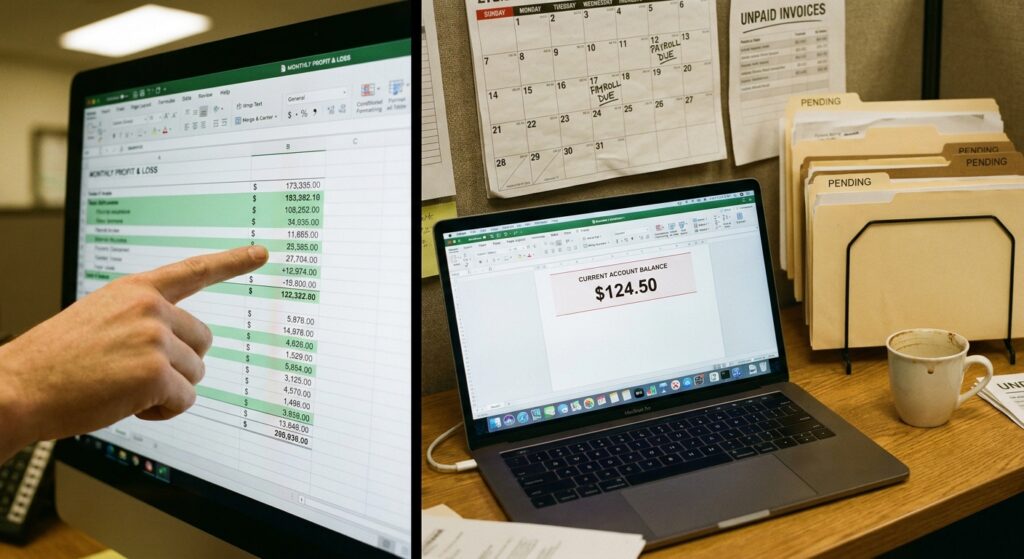
Your business can be profitable and still constantly run short on cash because profit and cash move on different timelines. You may be earning money on paper while cash is tied up in receivables, inventory, equipment, work in progress, or jobs you’ve already paid to deliver. Growth can make the squeeze worse. And if the same shortage keeps coming back, the problem may not be “cash flow” at all. It may be exposing how the business sells, bills, delivers, collects, and makes decisions.
What is actually happening
Your P&L says you made money. Your bank account has… some questions.
At first, this feels ridiculous. You sold the work. You delivered the work. Revenue is up. The accountants says the company is profitable, yet payroll hits Friday and suddenly everyone is doing mental gymnastics around which deposits are supposed to land first.
The first thing to understand is fairly simple: profit measures whether the business earned more than it spent. Cash flow tells you when the money actually showed up and left.
Those two timelines can be very different.
You can invoice a customer today and record the revenue while waiting 30, 45, 60, or more days to actually get paid. Meanwhile, payroll does not care about your customer’s AP department. Neither do suppliers, insurance, rent, fuel, materials, taxes, equipment payments, or the dozen other things that hit your account while that invoice is still sitting in receivables.
If you run a project-based business, the gap can get even uglier.
A construction company may have labor and subs in the field, materials purchased, pay applications submitted, change orders waiting for approval, and retainage sitting somewhere in the future. The job may be profitable. The backlog may look fantastic. Cool.
You still have to fund the work between now and getting paid.
That is the visible cash problem.
But when the squeeze happens repeatedly, I would look beyond the bank balance.
Because sometimes you have a timing problem. Sometimes you have a margin problem.
And sometimes your cash-flow problem is actually an operations problem wearing a finance costume.
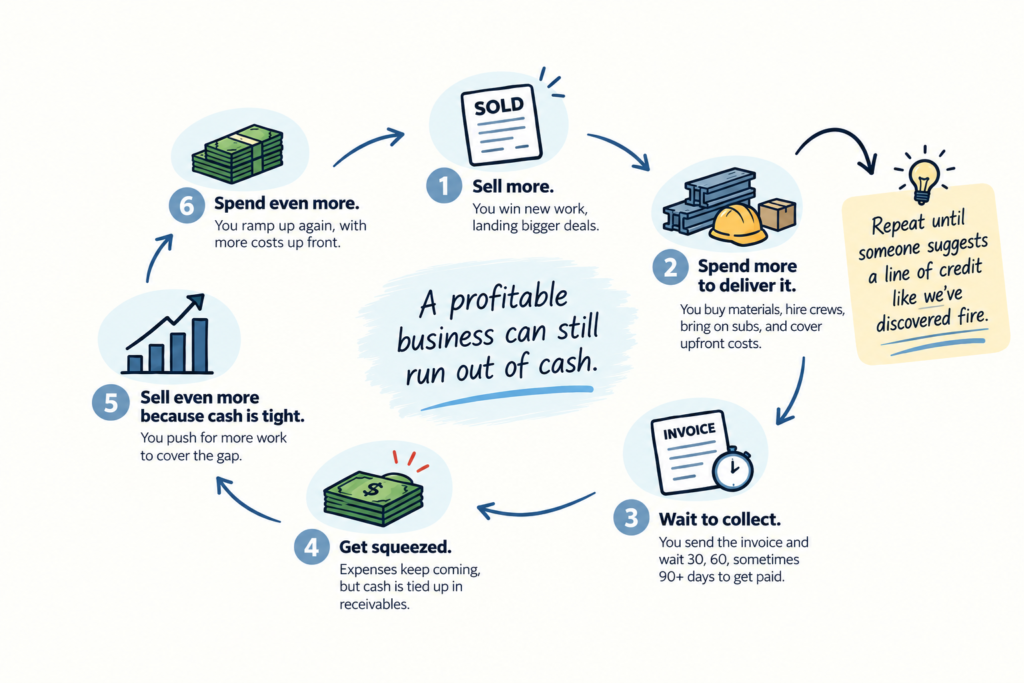
Growth can make a healthy business feel broke
More sales sound like the obvious answer when cash gets tight.
Sometimes they are. But growth requires cash before it produces cash in a lot of businesses.
You hire because you won more work. You add equipment because capacity is tight. You buy more material. Your team works more hours. Your subcontractors invoice you. Maybe you take on a larger customer with longer terms because landing the account felt like a major win.
Revenue goes up. So does the amount of money you have floating outside your bank account. This is one reason a business can feel financially worse during a period that looks successful from the outside.
The problem isn’t growth itself. The problem is growth moving faster than the operating structure underneath it can support.
If every new dollar of revenue requires you to front another dollar somewhere else for weeks or months, you need to know that before you stack more sales on top of it. Otherwise, the business can enter a pretty terrible cycle:
Financing can absolutely be useful. But first, you need to know what you’re financing.
The 5 things to inspect first
You do not need seventeen new dashboards to figure out where to start. You need to trace the money through the actual business.
1. Look at when you earn revenue versus when you collect it
Start with accounts receivable.
Not just the total number. Look at who owes you money, how old those invoices are, what the agreed terms were, and when customers actually pay. A contract that says net 30 means very little if your largest customers consistently pay in 52 days and everyone in the company plans cash as though they pay in 30.
Then look upstream.
How quickly does the invoice go out after the work is completed? Who owns that? What information do they need? What routinely delays it?
I’ve seen plenty of problems labeled “customers pay slowly” when part of the delay happens before the customer ever receives the bill. If work was completed Tuesday but invoicing waits until someone remembers the following Friday, that is not an accounts-receivable problem yet. That’s an operating delay.
2. Trace what you have to pay before the customer pays you
Now look at the other side of the timeline. When do payroll, materials, subcontractors, equipment, inventory, fuel, vendors, insurance, or other delivery costs leave the business?
You are looking for the gap between cash going out to fulfill the work and cash coming back in from the customer.
For some businesses, that gap is small. For others, you’re essentially financing your customers. And as the company grows, you’re financing more of them at once.
This is especially important in businesses where jobs span months, customers have significant purchasing power, or billing depends on approvals, milestones, documentation, or closeout.
3. Find the work that looks profitable until reality shows up
A healthy gross margin on the original estimate does not tell you whether the work stayed healthy.
Look for rework. Unbilled scope. Overtime. Expediting. Excess material. Missed change orders. Discounts your team gives to end a fight. Projects that drag three weeks past the planned finish. Senior people jumping in to rescue work that was priced assuming junior labor.
None of those things need to be catastrophic individually, and that’s precisely what makes them easy to ignore.
But if your organization repeatedly leaks small amounts of margin during delivery, your sales numbers can look strong while the cash never seems to accumulate.
The question isn’t only, “Did we sell profitable work?” Ask, “Did the business deliver it the way we priced it?”
Those are not always the same answer.
4. Look for handoffs that slow down money
Cash flow is surprisingly good at exposing lousy handoffs.
Sales promised something operations didn’t know about. The project manager needs documentation from the field. Billing needs something from the project manager. The customer is disputing a line item nobody owns. A change order is technically agreed to but hasn’t been signed. Someone noticed the problem three weeks ago, but everyone assumed someone else was handling it.
Individually, these look like administrative annoyances, but collect enough of them and you have a cash-flow problem.
This is why I wouldn’t isolate finance from operations when diagnosing recurring shortages. Your accounting team can report what happened to the money. They can’t single-handedly fix every behavior elsewhere in the company that determines when the money moves.
5. Compare growth decisions with the cash they require
Before the next big customer, market expansion, equipment purchase, hiring round, or aggressive sales push, ask a less exciting question: What does this growth require us to fund before it pays us back?
Maybe the business can comfortably carry it. Maybe customer deposits or milestones cover much of the exposure. Maybe existing cash reserves are more than sufficient.
Or maybe every “great new opportunity” quietly increases payroll and receivables while shrinking the margin for anything unexpected.
That doesn’t automatically mean don’t grow. It means stop treating revenue as though it arrives in the bank the moment someone signs the contract.
When a cash-flow problem becomes an operations problem
A temporary cash shortage can be exactly that: temporary.
A large customer pays late. Equipment fails. A project start shifts. Two major expenses happen to land during the same week.
Businesses deal with timing issues, but what deserves more attention is the problem that keeps returning in roughly the same form.
You are always waiting on invoices. Billing is always behind. Projects always take longer than expected. Someone always has to chase approvals. Customers routinely dispute charges. Sales keeps committing to terms operations struggles to deliver. Change orders consistently sit unapproved. Your team doesn’t know which customers should be escalated until the situation is already ugly.
At that point, cash is giving you information. The bank balance is the scoreboard, while the game happened somewhere else. And for what it’s worth, writing another collections procedure likely won’t fix a sales-to-operations handoff that keeps producing billing disputes.
Replacing the accounting person won’t fix project managers who don’t have clear ownership of job financials. Getting tougher with customers won’t fix invoices your own team sends two weeks late.
A recurring financial symptom deserves a wider diagnosis.
What not to assume: “We just need more money”
When cash gets tight enough, the conversation usually moves toward capital.
Should we borrow? Do we need an investor? Should we increase the line?
Maybe.
Capital is useful when you understand the economic reason you need it.
A line of credit can make perfect sense when you have a predictable timing gap between paying for work and collecting profitable receivables. Equipment financing can make sense when an asset supports productive capacity over time. Outside investment may make sense when the business has a deliberate growth strategy requiring more capital than existing cash flow can responsibly support.
But borrowing money to cover a recurring operating leak is different.
If invoices consistently go out late, more capital gives the problem a bigger cushion. If margins disappear during delivery, debt gives you more time to lose them. If sales growth creates commitments the business cannot finance, an investor may fund faster growth into the same constraint.
Money can solve a capitalization problem. It can’t organize a broken handoff.
Before you add capital, be able to explain exactly where the current cash goes, why the gap exists, whether it is temporary or structural, and what changes if you put another $500,000 into the business.
If that answer is basically, “We’ll finally have some breathing room,” keep digging.
I get it! Breathing room is valuable, and you should still know what’s making it disappear.
Frequently Asked Questions
This is not a complete list of the things I get asked, but the things I get asked quite often.
How can a profitable business still run out of cash?
A profitable business can run out of cash when money leaves the company faster than profitable revenue turns into collected cash. Profit may already include revenue customers haven’t paid yet, while payroll, suppliers, debt payments, equipment purchases, taxes, and other cash obligations still have to be funded.
The bigger the timing gap, the more working cash the company needs. If that gap grows alongside the business, an apparently successful company can become increasingly cash-starved.
What is the difference between profit and cash flow in a growing business?
Profit tells you whether the business earned more than its recognized expenses, while cash flow tells you when money actually entered and left the bank account. A company can therefore show a profit before it has collected the cash related to that profit.
For an owner, both views matter. Profit tells you whether the underlying economics work. Cash flow tells you whether you can fund those economics in real life.
Can growth make cash flow worse even when sales are increasing?
Yes, growth can make cash flow worse when the business has to spend money to deliver new sales before customers pay. More revenue can mean more payroll, materials, inventory, subcontractors, equipment, or receivables all at once.
Growth magnifies whatever cash cycle already exists. If the cycle is healthy, growth may strengthen the business. If the cycle is already stretched, adding volume can stretch it further.
How do receivables, payment timing, and customer terms create a cash squeeze?
Receivables create a cash squeeze when the business has earned revenue but cannot use that money yet because the customer has not paid. The longer the delay between delivering work, invoicing, and collecting, the more cash the business must supply in the meantime.
Customer terms are only part of the picture. Look at your actual billing and collection behavior too. A 30-day term paired with a 10-day internal invoicing delay has already become a 40-day problem before anyone pays late.
When is a cash-flow problem actually an operations problem?
A cash-flow problem is likely connected to operations when the same delays, disputes, rework, margin losses, billing problems, or handoff failures keep creating cash pressure. Finance may be where the symptom becomes visible, but the cause can start much earlier in sales, delivery, project management, or decision-making.
Follow the money backward. Find the point where the business repeatedly slows, loses, or delays it.
Should I bring in an investor or borrow money to fix cash flow?
Borrowing or outside investment can help when the business has a clear, understood need for working or growth capital, but it will not automatically fix a recurring operational problem. Before adding capital, identify why cash is short and what specifically the new money will fund.
If the problem is a predictable timing gap, financing may be appropriate. If the company is continually leaking margin or delaying its own collections, fix that too or the new capital may disappear into the same pattern.
Why does my business have plenty of work but still feel cash-starved?
Having plenty of work does not guarantee that the work is generating usable cash at the moment you need it. Backlog, signed contracts, purchase orders, and unpaid invoices may represent future cash while the company is funding today’s delivery costs.
This shows up clearly in project-based businesses. A full schedule can actually increase the amount of cash required if multiple jobs need labor, materials, or subcontractors before their payment cycles catch up.
What to do next
Take one recent stretch where cash felt unnecessarily tight – ideally 60 to 90 days – and trace the money backward.
Start with the shortage.
- What payments were due?
- What cash were you expecting?
- What had not been collected?
Then keep going.
- Why wasn’t it collected?
- Was the invoice late?
- Was the job late?
- Was the amount disputed?
- Was a change never approved?
- Did the work cost more than expected?
- Did someone make a commitment without understanding the downstream cash requirement?
You are not trying to blame whoever touched the problem last. You’re trying to find where the pattern actually begins.
And if you end up with six different symptoms crossing sales, operations, finance, leadership, and project delivery, don’t randomly pick the one yelling the loudest.
That is exactly the kind of knot worth untangling through a broader Business Clarity Assessment.
Because the useful question isn’t only, “How do we get more cash?”
It’s: What keeps happening inside this business that prevents profitable work from turning into cash we can actually use?
Get clear on that, and the next decision gets a whole lot easier.
-L
Leave a Reply