
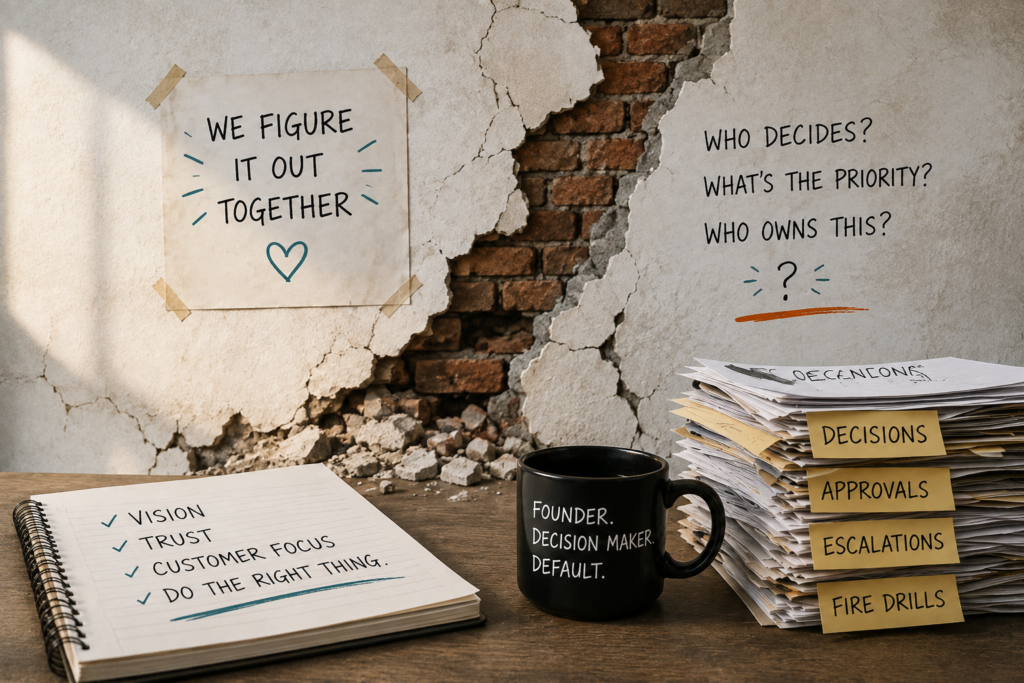
Why Company Culture Breaks as Your Business Grows
I worked at a very small company where everyone started in customer service. Sales. Tech. Leadership. Everybody.
At the time, I didn’t think of that as scaling company culture. Honestly, I’m not sure anyone else did either. It was simply how the company worked. You learned the product by hearing customers complain about it. You learned where sales had overpromised because you were the one explaining the gap. You learned which software problems mattered because an actual human on the other end of the phone was trying to get something done.
It worked remarkably well.
For a while.
Then the company grew.
More developers came in. More product people. More specialization. More “senior” titles. Teams started forming around different parts of the business, and people who used to share context naturally began experiencing entirely different versions of the company.
I remember being excited about the growth. More people meant more capability. More structure. More chances to fix things that had been held together with workarounds and institutional memory.
Instead, I started noticing something else.
The company still thought it operated like the smaller version of itself. It didn’t.
That is one of the strangest growing pains in a business because nothing necessarily looks broken at first. You’re hiring. Customers are coming in. The team is bigger. There may even be more money moving through the business than ever before.
But people start saying things like: “I didn’t know we decided that.” “I thought she was handling it.” “Who approves this now?” “Nobody told our team.” “I assumed he had authority to make that call.”
And eventually, the owner says some version of, “We never used to have these problems.”
Exactly.
You also never used to have 40 people.
Key Topics
- Why growing pains show up when a company scales from a small team
- How informal communication starts breaking as headcount grows
- Why scaling culture requires more clarity, not more control
- How unwritten rules create confusion across growing teams
- Why founders become bottlenecks as the business expands
- What actually needs to change when scaling company culture
- How to tell whether your business is experiencing scaling strain
The culture didn’t disappear. The conditions changed.
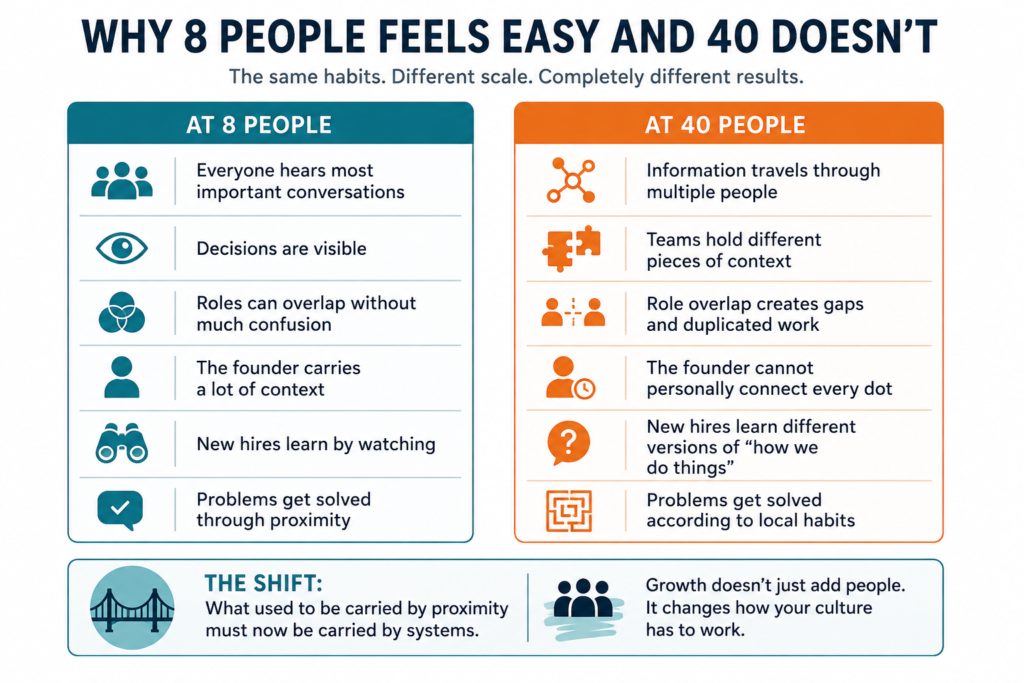
When you have eight people, a shocking amount of your business can run on proximity. Someone overhears the conversation. The founder answers a question from across the room. A customer issue comes in and three people immediately know the history. Someone notices that a teammate looks overwhelmed and jumps in. Nobody writes down who owns a decision because everybody already knows who usually makes it.
That can feel wonderfully human. Sometimes it is wonderfully human. It is also an operating system built almost entirely on shared context, however, shared context has limits.
Once the company grows, people are no longer hearing the same conversations. They are not working with the same customers. They may rarely interact with the founder. A new employee cannot absorb seven years of company history by sitting near the right person for three weeks.
Current research and guidance on scaling organizations points to the same basic pressure: as companies expand, informal communication stops reaching everyone and communication systems have to become more deliberate.
That does not mean your company needs seventeen meetings, a 48-page employee handbook, and a values committee debating whether “excellence” should be replaced with “exceptional excellence.”
Please don’t.
It means something much simpler: The culture that grew through proximity now has to grow through clarity.
That is a different job.
One company’s culture can quietly become five
This was the part I did not understand early in my career: I thought a company had a culture.
As the small company grew, I started seeing how naïve that was. The developers who handled production problems had one experience of the company. The developers building future products had another. Sales had another. Customer service had another. Leadership had another. They were technically employed by the same organization, but they were not always living in the same one.
The people fixing problems saw every shortcut and every downstream consequence. The people building new things were measured differently and experienced different pressure. Priorities changed depending on whose meeting you had just left. Decisions made in one part of the business created work somewhere else, often without anyone seeing the full chain.
Nobody had sat down and designed five different cultures.
That’s how this usually happens.
Culture is rarely wrecked because leadership suddenly announces, “Starting Monday, we’re going to become wildly inconsistent.” It happens through accumulation. A manager rewards one behavior, but another manager discourages it. One team learns that bringing bad news early is appreciated, while another learns that bad news gets you interrogated for 45 minutes, so maybe wait until you have a solution.
Now multiply those little lessons across 40 people.
Scaling company culture is not primarily about protecting a feeling. It is about deciding which behaviors should survive growth, then building a system that actually supports them.
The unwritten rules become the real problem
Small businesses love unwritten rules.
Not intentionally. They just accumulate because writing things down feels unnecessarily formal when everyone already knows.
“Jane handles those.” “Ask Mike before you send it.” “The owner likes to review those first.” “We usually do that on Thursdays.” “Technically you can decide, but I’d probably run it by her.”
That last one is my favorite. Nothing says autonomy quite like, “You’re empowered, but please seek unofficial permission first.”
At eight people, those rules can work because new team members learn them quickly. At 40, they become organizational folklore.
Some people know the folklore. Some know half of it. Some learned a version from a manager who left six months ago.
And the founder is wondering why apparently intelligent adults keep asking questions that everybody should already know. They don’t know because the business never actually decided what everyone should know.
That is not an intelligence problem. It is not a motivation problem. And in most cases, it is not because your new employees “just don’t get the culture.” The culture relied on access to context they no longer have.
That is a design problem.
Growth exposes what the founder was quietly holding together
This is where the conversation gets a little uncomfortable.
At eight people, the founder can compensate for a ridiculous amount of organizational ambiguity. You remember what the customer was promised, why the exception exists, and which employee needs more context versus less interference. You make three hallway decisions before lunch that save everyone else two days of untangling.
That looks like speed. For a while, it is speed.
Then the team grows and the exact same behavior becomes a bottleneck. Now managers wait for you because your judgment has never been transferred. Employees send questions upward because exceptions were always handled personally.
Teams hesitate because they have learned that the “real” decision can still be changed once you hear about it. You hire managers, but the business keeps teaching them to report instead of manage. This is one of the clearest signs of scaling strain I see in growing companies. The org chart says 40 people. The operating model still says eight people plus 32 helpers.
That will get heavy fast.
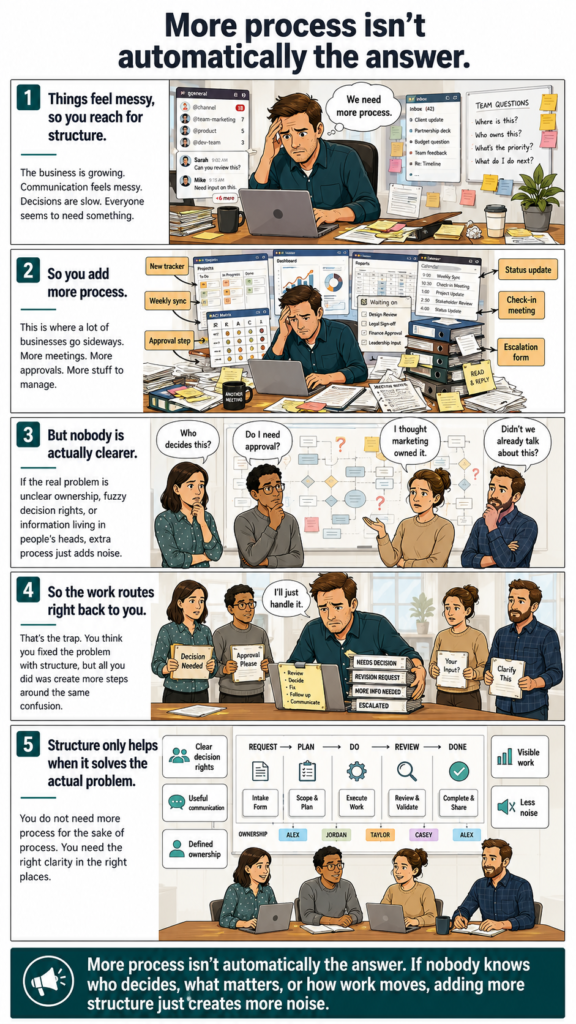
More process isn’t automatically the answer
This is usually the point where somebody buys a framework. I understand the impulse.
Things feel messy, so structure sounds soothing.
New meetings appear. New scorecards. New planning cadences. A new piece of software gets purchased because apparently the previous six pieces of software simply lacked sufficient enthusiasm.
Some of those things may help, but structure only helps if it solves the actual problem.
I have taught frameworks. I have implemented them badly, then adequately, then much better. One lesson survived every version: Frameworks are wonderful teachers. They are terrible saviors.
If the real problem is that nobody knows who can make a customer decision, another weekly meeting does not fix that.
If the real problem is that managers get overruled every time they make a call the founder would have made differently, a values workshop does not fix that.
If the real problem is that important work still lives in hallway conversations, adding a dashboard nobody trusts does not fix that.
And if leadership keeps rewarding heroic rescues, you cannot put “sustainable work” on the wall and expect anyone to believe you.
Your culture is the behavior your system teaches people is safe, useful, and rewarded. That gets much easier to see as you grow.
What actually has to change when you scale culture
You do not need to preserve every part of your eight-person culture.
Some of it should go.
The founder approving everything? Let it go.
The employee who somehow knows every customer workaround? Useful person. Terrible system.
Important decisions happening through whoever happens to be standing nearby? Charming at eight. Chaos at 40.
What you do want to preserve is more important.
Maybe it is candor. Maybe people have always been willing to raise a problem early. Maybe customers have always gotten fast, thoughtful answers. Maybe people help outside their lane when something genuinely matters. Maybe your company is unusually good at changing direction without turning every adjustment into a crisis.
Keep those things, but stop assuming they will reproduce themselves automatically.
Make decision rights clear enough that a manager can actually manage. Make important work visible enough that people are not coordinating through memory. Build communication rhythms around what teams genuinely need to know, not around management anxiety. Pay attention to handoffs because that is where a growing company starts creating little black holes of responsibility.
And perhaps most importantly, look closely at what leadership rewards under pressure.
That is the culture people believe.
Not the poster. Not the onboarding slide. Not the founder story everybody has heard 14 times.
The Tuesday afternoon decision when a client is angry, revenue is at risk, and somebody has to decide whether the values still count.
Your old culture wasn’t wrong
I think this part also matters.
When a company begins experiencing growing pains, leaders can become oddly nostalgic.
“We used to be so close.” “Everyone used to just pitch in.” “We never needed all these rules.” “I knew what everyone was working on.”
Of course you did. There were eight of you.
The mistake is not that you once ran the company that way. That closeness, flexibility, and shared context may be exactly what helped you grow. The mistake is demanding that the business stay there after the conditions have changed.
I have watched companies do this at 40 people, a few hundred people, and inside organizations with thousands. The scale changes. The pattern really doesn’t. People keep trying to solve today’s coordination problems using yesterday’s relationships. Eventually the relationships cannot carry the load. Then good employees start looking less capable than they are. Managers look indecisive. Teams look siloed. The founder feels dragged back into details they thought they had escaped two hiring rounds ago.
Everybody gets frustrated with everybody else.
When what actually happened is much less personal. The business grew. The system didn’t grow with it.
That is fixable, but only once you stop trying to get the eight-person company back.
Because you did not build all this just to spend your days recreating the conditions from when everybody fit around one table. The next version can still be human. It can still be fast. It can still feel like you.
It just needs to be able to hold more people without requiring you to personally hold all of them together.
-L
Frequently Asked Questions
How do you scale company culture?
You scale company culture by turning important unwritten expectations into clear, repeatable behaviors. That includes decision rights, communication norms, management expectations, handoffs, and what leadership rewards. The point is not to formalize everything. It is to make sure the parts that matter no longer depend entirely on proximity to the founder.
How do you maintain company culture during rapid growth?
Start by deciding what is actually worth maintaining. Some early-stage habits work because the company is small, not because they are culturally important. Protect the values and behaviors that make the business stronger, then redesign communication and decision-making so those behaviors can survive with more people.
How do you maintain company culture as a company grows?
Do not treat culture as something separate from operations. People learn your culture through everyday decisions: who has authority, how mistakes are handled, whether bad news can travel upward, what gets rewarded, and whether leaders behave consistently when the pressure is on.
Scaling Strain Self-Assessment
If your business has grown but still seems to route decisions, context, and problems back through the same few people, start there.
Use the Scaling Strain Self-Assessment and pay attention to what you checked quickly, without having to debate it.
Those are usually the places worth examining first.
Not because your culture is failing, but because it grew, and now the way you run the company has to catch up.
Leave a Reply