
Meeting Cadence for a 10 to 50 Person Business
For a business with 10 to 50 people, I could potentially recommend leadership meetings, one-on-ones, operating reviews, and quarterly and annual planning, with short team huddles when the work changes often enough to need them. That said, I’d recommend none if the meetings lack a specific purpose, someone responsible for running them, and clarity about who can make which decisions. Otherwise, you can fill the calendar and still have everyone waiting on an answer.
What is a meeting cadence?
A meeting cadence is the fixed set of recurring meetings a business runs, how often each happens, and what each one is for. Running a good cadence means fewer meetings, not more.
What can a cadence look like?
Use this as a starting schedule for a small business, then adjust it to the work your team actually does. These are different conversations for different groups; every employee does not need to attend every meeting.
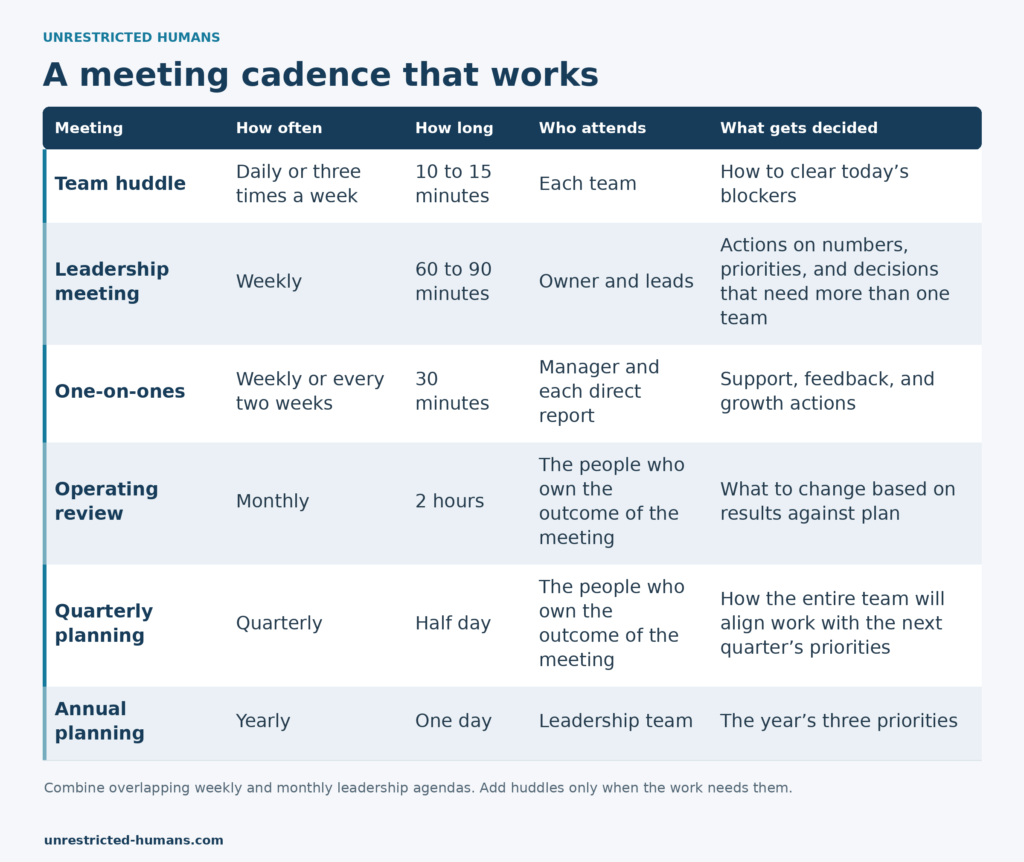
Don’t stack a two-hour operating review on top of a weekly leadership meeting with the same people and the same agenda. In review week, combine the overlapping work into one longer session. Keep urgent weekly decisions on the agenda and use the remaining time to examine results.
Why a full calendar can still leave the business waiting
You can have plenty of meetings and no dependable place to resolve anything. A manager raises a problem on Monday, someone asks for more information, and the same problem turns up again on Thursday. By Friday, you’re handling it between calls because the work cannot wait any longer.
Before adding another meeting, look at what prevented the decision. Did the team lack current information? Did two managers disagree about priorities? Was everyone waiting for your approval because nobody had agreed on what they could decide themselves?
Those are different problems. A recurring invitation can give the conversation a place to happen, but it cannot supply missing information or grant authority nobody has discussed.
Your involvement isn’t automatically the problem, either. Some decisions belong with the owner. The trouble starts when nobody can tell which ones do, so everything comes back to you just in case.
What each meeting is for
Team huddle
The huddle coordinates today’s work: what changed, what is blocked, and who needs help from whom. In a construction business, that might be a delayed delivery changing where a crew can work today. Agree on the immediate adjustment and assign any follow-up. Do not use the huddle for an individual’s performance review. That conversation belongs in private, and the rest of the team has work to do.
Leadership meeting
The weekly leadership meeting turns current numbers and priorities into decisions across the business. Share routine updates beforehand so the conversation can focus on exceptions, tradeoffs, and commitments. End with a record of what was decided, who owns the next action, and when it is due. Do not use this meeting to conduct a detailed review of every task on every team’s list. Bring the work that needs leadership attention.
One-on-ones
One-on-ones give a manager and each of their employees room to discuss support, feedback, workload, and growth before those conversations become urgent. Ask where the person is stuck, what they need from you, and what expectations need clarification. Our one-on-one meeting template gives that conversation a structure.
Operating review
Many companies have operating reviews 1-2 times per month. This meeting asks whether the business is producing the results you planned for and what needs to change. Look across financial results, delivery, capacity, and customer commitments rather than reviewing each department in isolation. Growing backlog, for example, deserves a different conversation if project managers cannot staff the jobs already sold. Don’t use this meeting to read a report aloud line by line. Circulate information first and focus the discussion on what went well, what didn’t go well, and what you’re going to try doing until the next review.
Quarterly planning
Quarterly planning sets the next quarter’s priorities based on current results, available capacity, and what the business needs next. Choose outcomes with accountable owners and make the tradeoffs explicit, including what will wait. Never leave this meeting without clarity on how the work you’ll do in that quarter aligns with your company’s goals.
Annual planning
Annual planning establishes the year’s three priorities and the financial and capacity assumptions behind them. Those priorities should give the leadership team a basis for choosing quarterly work, spending money, and declining distractions. The annual planning article goes further into that work. Capture immediate issues for the weekly meeting and keep the annual conversation focused on the year.
How to cut the meetings you do not need
Open your calendar to last month and look at what the meetings actually produced. Any recurring business meeting without a decision to make or an owner responsible for its purpose: Cancel it, combine it with a meeting that already covers the work… Whatever you do, don’t keep it just because.
Now remember: This is an audit of operating meetings, not your one-on-ones. In no way is this an argument against training or spending time together. For a one-on-one, the decision might be an agreed support action or development step. You’re looking for a useful outcome.
As you go through your calendar audit, start with these four checks:
- Find the decision. Pick three recent meetings and identify what changed because people attended. If all you can find is information people could have read, question the meeting.
- Find the person who could make it. Was that person present? Could the attendees act within agreed limits, or did everything still need approval afterward?
- Check when the information arrived. Did people have current numbers before the meeting, or did half the session disappear into finding them? A weekly decision cannot run on information that arrives once a month.
- Follow one commitment. Take an action from last month’s notes and trace it to completion. If it disappeared until someone remembered to ask, look at where actions live and how they’re reviewed.
Invite people because they can decide, contribute necessary information, or own the resulting work. If they only need to know the outcome, send them the decision afterward. Once you’ve removed the overlap, use the table above to fill any real gaps.
What not to assume: another meeting will fix communication
Sometimes you do need another recurring conversation. Managers who never have a reliable place to resolve competing demands may benefit from a weekly leadership meeting. But if those managers already meet twice a week and still cannot agree on priorities, adding Friday won’t settle the disagreement.
The same applies to meeting software. A tool can keep an agenda and record actions. It cannot decide whether a project manager can approve a change order, which customer commitment takes precedence, or who can move a crew between jobs. Agree on those boundaries, then use the tool to make them visible.
Change the frequency when the work requires it. Change the decision rules when the work is waiting for permission.
Signs your meeting cadence is broken
Three patterns are worth investigating before you change the calendar:
- Decisions get made in hallways. Informal conversations are useful. But if the real decisions consistently happen after the meeting, ask what was missing in the room. Then record the decision where everyone affected can see it.
- The same topic shows up in three meetings. Trace why it keeps moving. It may have no clear owner, require information nobody has brought, or cross teams that have different priorities. Give it a specific decision and a place to resolve it.
- People skip meetings without consequence. If their absence affects nothing, they may not need to attend. If it stalls decisions and everyone accepts that, the meeting’s purpose and attendance expectations need attention.
Ask what makes each pattern necessary. If managers leave the leadership meeting and immediately line up outside your office, examine what they couldn’t say or decide together before requiring another meeting.
Frequently asked questions
How often should a leadership team meet?
A leadership team should meet weekly to review current performance, resolve issues across teams, and agree on next actions.
Use the same time each week so people know where to bring decisions that can wait. Give urgent issues a separate escalation route; a customer commitment or stopped job should not sit untouched until Tuesday.
How long should a weekly meeting be?
A weekly leadership meeting should usually last 60 to 90 minutes, with routine updates shared beforehand and most of the time reserved for decisions.
If you regularly run over, inspect the agenda before extending the meeting. Too much reporting, missing information, or detailed problem-solving that needs only two attendees can consume the session. Give those two people a follow-up and a deadline.
Do small teams need a daily huddle?
Small teams need a daily huddle when the work changes often enough to require coordination.
Changing jobsite conditions, dispatch assignments, or crew availability can justify a short daily huddle. A team working on stable assignments may only need to meet three times a week, or less. Decide based on what changes between meetings, not because daily huddles appear on someone else’s calendar.
What’s the difference between a leadership meeting and an operating review?
A leadership meeting resolves near-term issues and commitments, while an operating review examines results against plan and decides whether the business needs to adjust. It also looks at how effectively the business worked as a team to achieve those results.
For example, the leadership meeting might resolve staffing for a delayed job. The operating review asks whether repeated delays are changing margin, capacity, or cash expectations. Connect the findings, but don’t repeat the same update in both meetings.
Does the owner need to attend every meeting?
The owner needs to attend meetings where their decisions or perspective are required, not every meeting in the business.
The starting schedule above includes the owner in leadership and planning conversations. Team huddles and managers’ one-on-ones should normally run without them. If routine work stops whenever you miss a meeting, check whether people have the information and authority to continue.
What should happen between meetings so decisions don’t get lost?
Between meetings, keep decisions and actions in one shared place, with a named owner and due date for each commitment.
A short decision record can explain what was agreed and why, so an absent colleague doesn’t have to reconstruct the conversation. Owners should update actions where the work is tracked. At the next meeting, review exceptions and missed commitments instead of rebuilding the entire list from memory.
What to do next
Start with last month’s calendar. Remove one duplicate meeting, clarify one decision that keeps coming back to you, and put the resulting actions somewhere the team can see. Try the revised schedule for a month and review whether decisions are happening sooner and commitments are getting finished.
If you find that meetings, priorities, and decision authority all need attention, see how we build operating rhythm with your team. The 12-question assessment is another starting point for examining how leadership and operations are working together.
Download the free one-on-one meeting template to start the weekly rhythm this week.
-L
Leave a Reply